
The Great Work Continues
Or as Solomon said, "This, too, shall pass – but not before it sucks."

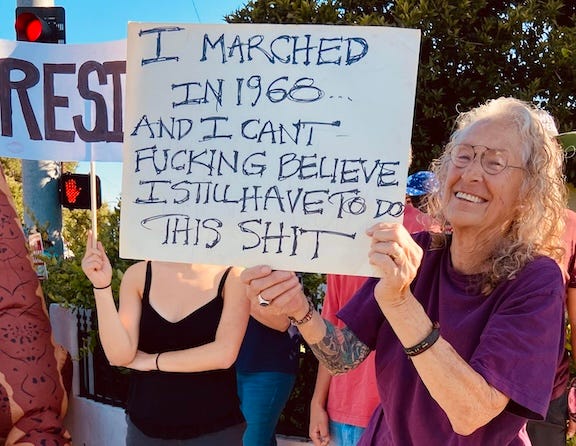
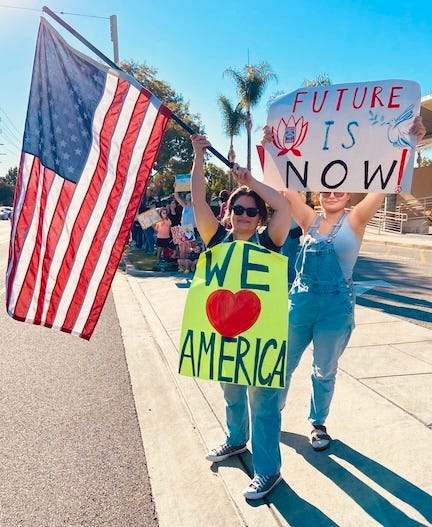
No Kings, October, 2025 • Photos © Josh Gershick
Last week, over dinner at our favorite mom ‘n’ pop Japanese/Korean mash-up cafe, in a nondescript strip mall in the Valley (where some of the best restaurants in LA lie hidden), two more friends told Elissa and me that they were emigrating to Canada.
Our beautiful, bright new buddies, Susanna and Leah, one trans, one cis, and barely into their 30s, were terrified, they said, and completing the necessary paperwork to leave the country.
“I keep hearing those voices of my ancestors in that shtetl saying, “Get out! Get out while you can!” said Leah.
That made nearly a dozen people we know who have left, are leaving or who may yet leave, pending the outcome of the midterm elections in November.
I hear those voices, too, and toggle between panic and resolve from day to day. “It’s astonishing how terrified I am to leave my house,” I wrote in my journal just weeks ago. Seeing footage of noncitizens and citizens alike dragged out of schools and workplaces and gunned down in the street has made me hyperaware of every movement in my neighborhood and every noise in the night. I often sleep in street clothes atop the bed so I’m ready for anything.
In my early twenties I worked for a time as a dispatcher for the Berkeley Police Department. One night when I was still in training, I took a 911 call from a woman who said she was being attacked.
“Help me! Help me! You must help me,” she screamed. “They are coming! They are coming! Help me! They are here!”
Through the woman’s piercing screams, I quickly noted her name and address, and assured her that help was on the way. But when I began to dispatch a cruiser, my training officer, listening in beside me, touched my arm.
“Good job,” she said. “No need to send a car.”
“What?” I was astonished. “That woman is being attacked.”
“No. Not here. Not now,” said my trainer. “That’s Mrs. Schwartz. She’s a Holocaust survivor. She calls every day. She is not in danger. Take her call, and be kind. Her attackers are ghosts.”
Though my own experience pales in comparison, I think I understand Mrs. Schwartz’s trauma response better today than ever. Many times this past year, I have awakened yelling at 3 a.m., certain that someone is coming through the door. And I know from talking with friends that I am not alone.
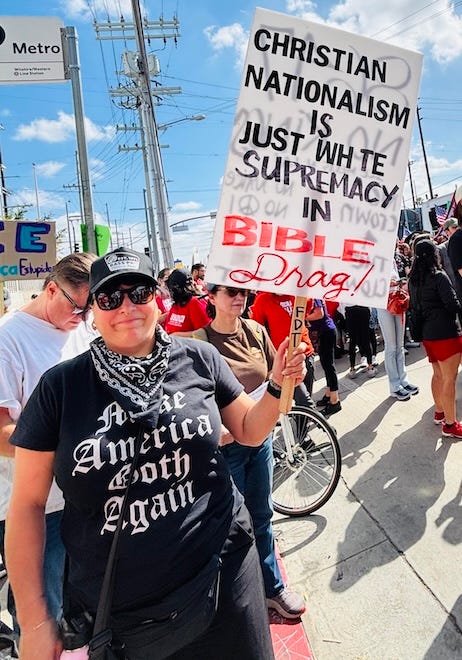
For the first time in its history, the Human Rights Campaign has officially declared a state of emergency for LGBTQ+ people. According to the HRC, more than 750 pieces of anti-LGBTQ+ legislation have been introduced or are pending in state legislatures across the United States, principally limiting the rights of transgender people to participate in public life. [i]
One such bill, HB 752, recently signed into law in Idaho, would make it a criminal act for any transgender person to enter even a single-stall bathroom that aligns with their identity, in any building or business, governmental or commercial. This includes bathrooms in any workplace, bar, restaurant, rest stop, gas station, hospital, airport, entertainment venue or coffee shop. Punishment for violating this law: One year’s imprisonment for the first offense, and five years’ imprisonment for the second.[ii]
Early in my medical transition, before I walked un-noticed, the single stall, gender neutral bathroom was for me an island of safety, a place to pee in peace. At that time, Starbuck’s was one of the only places these bathrooms existed, and if I felt the call of nature there was no relief until I found one, however long it took me.
Imagine working all day, or shopping or dining, without being able to access a bathroom, or being forced to use a bathroom not aligned with your gender, placing you in harm’s way. These restrictions, and others, set transgender people apart and target us for abuse as surely as if we were required to wear a yellow star or a pink triangle.
Back at the dinner table, I couldn’t tell our new friends, “Don’t go.” That’s their decision to make. But I wanted to say, “Please stay and fight, because we are not going back into a darkened closet. We refuse to return to a shadowy. segregated, restricted world.”
Maybe if I were 30 years younger and less rooted in community, I might just say “fuck this mess” and move on to a new, putatively stress-free spot – Toronto or Vancouver, Sydney or Lisbon – where there is no Confederacy trying to rise again like a moldering zombie.
Or maybe not.
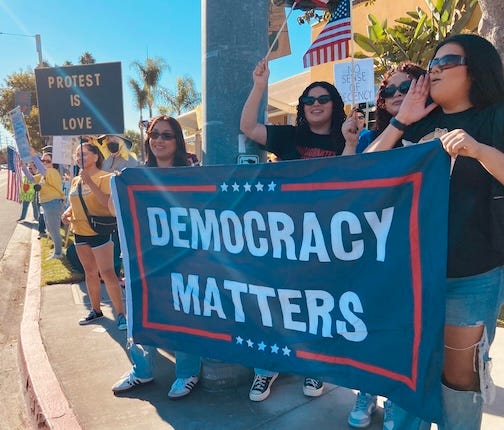
But I get it: My friends were born in the 1990s: The first two-thirds of their lives saw steady progress: We’d decriminalized same-sex intimacy nationwide (Lawrence v. Texas, 2003); Gay, lesbian and bisexual people had won the right to serve openly in the military with the repeal of Don’t Ask, Don’t Tell (2010); We’d struck down the Defense of Marriage Act, which had defined marriage as only between a man and a woman (United States v. Windsor, 2013); and same-sex couples had achieved the federally recognized right to marry (Obergefell v. Hodges, 2015).
And then ...WHAM! We’ve had nearly a decade (and counting) of supreme fuckery, mind-numbing stupidity, gleeful cruelty and stunning capitulation by people and companies more interested in making a dollar than in protecting democracy.
But I’m old enough to see how America has progressed – and will continue to progress if we stand our ground. In fact, the amount of progress we have made in my own lifetime has been considerable.
I was born in the last quarter of 1959, in Oakland, California. At that time, homosexuality was considered a crime in every state, and the American Psychiatric Association considered same-sex desire a mental disorder.
Despite Brown v. Board of Education (1954), schools remained largely segregated, along with restaurants, parks and theaters. (It was also nearly impossible for Black Americans to vote throughout the South until the Voting Rights Act of 1965, which the hostile, corrupt majority on the U.S. Supreme Court just gutted).
Abortion was illegal across America then. To relieve their burden, working women relied on backstreet providers, while wealthier women took an unplanned “holiday” to Mexico or Cuba. Every woman in my mother’s circle knew someone who had died of an unsafe, illegal abortion.
Banks often mandated a male co-signer (a husband or father) for a woman who wanted a credit card, loan or mortgage.
American universities, particularly Ivy League schools, imposed strict quotas to limit the admission of Black, female and Jewish students.
And in every school I attended there were childhood survivors of polio, kids walking haltingly in leg braces; kids who’d caught the disease before the advent of the Salk vaccine in 1955, and were left permanently disabled.
Over the years, as I grew up, things changed. Our country moved forward, spurred on by the democratizing Black, Women’s and Gay Liberation movements of the 1960s and 70s.
The United States kept progressing – not without struggle – and it was beginning to become that more perfect union. It seemed to me as a young person that we as a country would only ever expand into a bright tomorrow.
Even through the AIDS crisis in my 20s; through clashes with the “Religious Right” and our ongoing battles for equality, I felt we were hurtling onward, building on the sweat and effort of so many, both celebrated and nameless, who’d invested themselves in Good Trouble.
And hadn’t Barack Obama been elected our 44th president, demonstrating that we could as a nation live up to our dearest ideals?
But here we are, in the whitelash, the feminine-hating, race-baiting, gender-essentializing, patriarchal pushback. This movement to turn back America’s clock to the 1850s, seeded by Republican extremists (aka “movement conservatives”) in 1960 – and incubated for nearly my entire lifetime – fully flowered in 2016 with the election of Donald Trump.[iii]
This didn’t happen overnight: The fix won’t be quick.
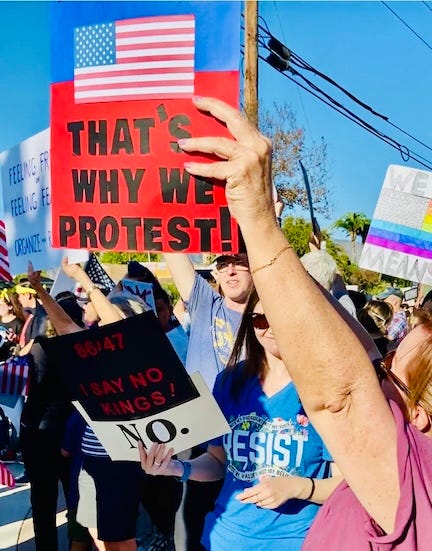
Still, we have glimpsed what America can be, and we are not reviving Dixie, no matter what the Supreme Court majority decides. And I could argue that the blowback is so big because our strides have been so great.
The abolitionist Frederick Douglass in a speech given in New York, in 1857, told us straight, no chaser, how it goes: “Power concedes nothing without a demand. It never did and it never will.”
That is why we resist. And why we will keep on resisting and marching and speaking up and out. And the message is this: We will not be cowed. American democracy will not die on our watch. Because it is our turn to fight for the next generation, to ensure their freedoms will expand, not contract. And because the cost of passivity is too high.
The great work continues.
[i] https://www.hrc.org/campaigns/national-state-of-emergency-for-lgbtq-americans
[ii] https://www.acluidaho.org/legislation/2026-hb-752-criminalizing-bathroom-use-for-trans-people/
The entire population of Idaho, by the way is two million – only fractionally larger than the San Fernando Valley section of LA with 1.9 million people. Transgender Idahoans are thought to be .4% of the state’s population, or roughly 8,000 people.)
[iii] Read the brilliant book, “How the South Won the Civil War: Oligarchy, Democracy, and the Continuing Fight for the Soul of America,” by Heather Cox Richardson; Oxford University Press, 2020.
I’ll be here fighting with you!
Such vivid and powerful writing! I really appreciate your honest, insightful reflections on the terror we are facing in our world today -- such as Idaho's HB 752 that makes going to the bathroom a crime. It is horrifying! With so much else going on, I wasn't even aware such a bill had passed. Thank you for writing about it -- I can only hope it will be challenged and overturned in the courts soon. Above all, thank you for your personal perspective on history and the progress this country has made in spite of today's injustices. And I agree: we have to keep fighting against forces that seek to erode democracy and steal our freedoms.